
Iron and Labor in the Revolutionary Era
Ironworks, like crucibles, functioned as melting pots of a sort in which capital, people, and ideas from Europe, Africa, and North America met, collided, and melded to form something new and uniquely American. -John Bezis-Selfa

In the very late evening hours of July 4, 1776, John Dunlap used the English Common Press that was in his shop to print the first copies of the Declaration of Independence. Dunlap, as with almost all printers in Colonial America, relied on a printing press and type imported from England.[1] For those readers interested in an extra bit of Philadelphia trivia: the first American-made printing press was manufactured in Philadelphia by clockmaker Issac Doolittle in 1769. He sold that press to a printer named William Goddard. Because there are no records indicating that John Dunlap ever purchased one of Doolittle’s creations, historians surmise that Dunlap’s press was of English origin. John Dunlap’s press was made of wood and iron, and iron was deeply connected to the fate of the American Revolution.
Printing Presses & Iron
Here at Common Press (so named because of the common press model of printing presses), the oldest printing press in the studio is a cast iron Washington handpress that dates to around 1900.
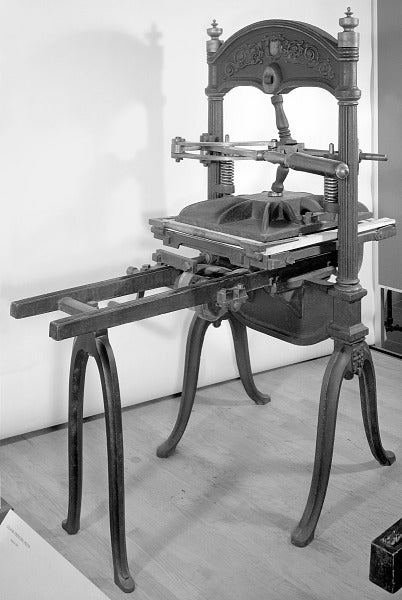
We will be utilizing this press in our “Typography of Independence” replica Declaration printings because its basic components are remarkably similar to the press that John Dunlap would have used. In fact, the structure of both this Washington handpress and Dunlap’s common press would have even been familiar to Johannes Gutenberg himself, although they were hundreds of years removed from his original innovation.
While Gutenberg’s original printing press has not survived, historians believe it was a modified wine or olive oil press. On these early presses, paper was laid over inky type and pushed under the press platen. The printers would pull a lever that turned a screw, so the platen exerted great pressure onto the paper and a crisp print was achieved. This basic design endured, but an iron hand lever became popular as opposed to all-wooden constructions. Later, both the common press and the presses Isaac Doolittle manufactured in the colonies had iron levers as well as iron screws.

Iron was attractive as a material for printing presses because it is very durable. The iron Washington Handpress has its origins in 1822 when R. Hoe & Coe of New York manufactured a press with a cast iron frame and a toggle joint instead of the typical screw. In 1829, Samuel Rust improved this design with his patent for a hollow cast iron frame with interior wrought-iron bars (this design resulted in a sturdy press that was at the same time relatively lightweight). This Rust design was purchased by R. Hoe & Co. and became known as the “Washington” press. Over 6,000 were produced and because they are not terribly heavy thanks to the hollow frame, the presses were shipped all over the United States and the around the globe.[2]
In addition to being a key element in this hand press, iron is of interest to Common Press and Fisher Fine Arts Library staff because it was a building material favored by Frank Furness, architect of the Anne and Jerome Fisher Fine Arts Library. Every day when visitors enter the library building lobby, they see an impressive four-story staircase decorated with wrought iron railings.

Like the Washington Handpress, the stairs are a combination of cast iron and wrought iron: cast iron newels are the larger posts at the base of the stairs, and wrought iron forms the decorations along the railings. In Frank Furness: Architect in the Age of the Great Machines, George Thomas writes, “Where British and most American architects in their native cities rarely used iron in a public manner, in Philadelphia, iron was a component of Victorian buildings of all classes and types. In their widespread use of iron, their original architectural vocabulary, and their functional plans, the architects of the city created an industrial identity that was as confounding to high-architectural critics as it was natural to the industrial client.”[3] The Fisher Library building was completed in 1891, but the “industrial identity” of Philadelphia dates back much further. In fact, the iron industry was well-established in Pennsylvania even before the American Revolution.
Iron Foundries and Labor in the Colonies
The Province of Pennsylvania (or, the Pennsylvania Colony) was a suitable location for foundries and iron mills because the area has all the natural materials necessary for iron production. In addition to a supply of iron ore near the surface of the ground, Pennsylvania had rich forests (to provide fuel for furnaces), running water (that could be harnessed to power the bellows of the furnace), and limestone (this served as the “flux”, a purifying element in the smelting process).[4] According to historian James Mulholland, “The Schuylkill River and its tributaries became the locations of the greatest concentration of ironworks in the colonies, with more than fifty furnaces and forges built before the Revolution.”[5] These ironworks were so large and involved that they were called “iron plantations”. An iron plantation contained thousands of acres of woodland to fell trees for fuel, the mines to excavate iron ore, and the foundries themselves. Workers would have lived on site in basic housing or log cabins, and because these plantations were far removed from urban centers, there may have been a store, an office, and sometimes grain mills and farmland to supply food to the workers. One historian of the iron industry in early Pennsylvania wrote, “In some respects, the iron plantations resembled small feudal manors of medieval Europe.”[6]
Calling these industrial sites “plantations” also gives an indication as to the conditions of labor. Historian John Bezis-Selfa explains, “Ironworks were expensive and risky ventures which required the marshalling of capital and labor on a scale and scope seen nowhere else in early Anglo America save on sugar plantations.” He explains, “Making iron was dirty, backbreaking, and dangerous work...”[7] Iron plantations relied on enslaved and indentured labor in addition to waged workers. Before the American Revolution there were over one hundred ironworks in Pennsylvania and New Jersey and “most, if not all, used slaves in their work forces.”[8] While ironmasters became some of the largest slaveholders in the Middle Colonies, slaves did not represent the largest portion of workers on iron plantations. Although a minority of the labor force, slavery was key to the management of labor dynamics. Bezis-Selfa explains: “slavery represented a powerful tool that (ironwork owners) used to discipline their workers by limiting the latter’s ability to negotiate terms of employment.[9] Thus, slavery was exploited as a method of controlling both free labor and the terms of indentured servitude. In this way we glimpse an ever-present issue throughout labor history (and indeed one that continues in labor conditions today): jobs are tenuous and never secure, and any worker who complains or makes efforts to organize can be threatened with replacement.
Iron and the Colonial Economy
To turn a profit, an iron plantation needed to extract iron ore, smelt it (melting and purifying the iron), and then process the material into bars called “pigs” or pig iron. Workers filled a range of roles: miners, colliers to produce charcoal and work the furnace, and founders to oversee the smelting – to name just a few key jobs. If there were additional skilled workers on site, the ironworks could also manufacture finished products such as pots, stove plates, and kettles.[10] By 1775, the American colonies (particularly New Jersey, Pennsylvania, and some of Virginia) were the world’s third largest producer of iron, easily outpacing the iron production of England and Wales![11]
The success of the iron industry in the colonies directly threatened the economic control of England. As a result, the Parliament of Great Britain passed The Iron Act of 1750, which banned the new construction of any ironware manufacturers in the colonies. This act, intended to stifle the growth of American ironworks, was largely ignored and “more than sixty operations made illegal by the Iron Act of 1750 were constructed in defiance of parliamentary regulation”, twenty of these illegal new furnaces and mills were built in Pennsylvania.[12]
When we see the beautiful wrought iron staircases in the Fisher Fine Arts Library, and the imposing cast iron Washington handpress in the basement of the building, we can remember the long history of ironworks in Pennsylvania and especially remember the labor that this industry was built on. Iron allowed the American colonies to revolt against Britain. In the first place, ironworks in Pennsylvania cast both cannons and cannon balls to outfit the Continental Army.[13]
Iron workers allowed the American colonies to revolt against Britain. In the first place, ironworks in Pennsylvania cast both cannons and cannon balls to outfit the Continental Army. [14] Without this artillery, the American Revolution could have been quashed by British forces. Just as important, however, American iron workers built a strong foundation for the young country’s economy; the success of ironworks proved the ability of the young colonies to be an industrial powerhouse on the global scale.
Sources
Thomas, Isaiah. The history of printing in America. With a biography of printers, In two volumes. New York, Burt Franklin: 1964.
Wroth, Lawrence. The Colonial Printer. The Southwroth-Anthoensen Press, 1938.
Hoe, Robert. A Short History of the Printing Press: and of the improvements in printing machinery from the time of Gutenberg up to the present day, 1902.
Thomas, George E. Frank Furness: Architecture in the Age of the Great Machines. Philadelphia: University of Pennsylvania Press, 2018.
Mulholland, James A. History of Metals in Colonial America. Tuscaloosa: University of Alabama Press. 1981
Bezis-Selfa, John. Forging America : ironworkers, adventurers, and the industrious revolution.
Kennedy, Michael. “Furnace to Farm: Capital, Labor and Markets in the Pennsylvania iron industry, 1716- 1789" University of TKTK.
Kennedy, Michael. “Iron Mining and Metallurgy” in Encyclopedia of the New American Nation ed. Paul Finkelman, 2006.
Binning, Arthur. “The Iron Plantations of Early Pennsylvania” The Pennsylvania Magazine of History and Biography, Vol. 57 No, 2 (1933), 117-137.
Footnotes
- Thomas, 219. ↩
- Wroth, 83. ↩
- Hoe, 9 and 10. ↩
- Thomas, 43. ↩
- Bezis-Selfa, 102 & Tunis, 113. ↩
- Mulholland, 73 ↩
- Binning, 118. ↩
- Bezis-Selfa, 10. ↩
- Kennedy, Michael. “Furnace to Farm”, 77. ↩
- Bezis-Selfa, 102. ↩
- Kennedy, Michael “Furnace to Farm”, 81 & Kennedy, Michael. “Iron Mining and Metallurgy”, 240. ↩
- Bezis-Selfa, 8. ↩
- Kennedy, Michael ”Iron Mining and Metallurgy”, 240. ↩
- Binning, 134.↩